
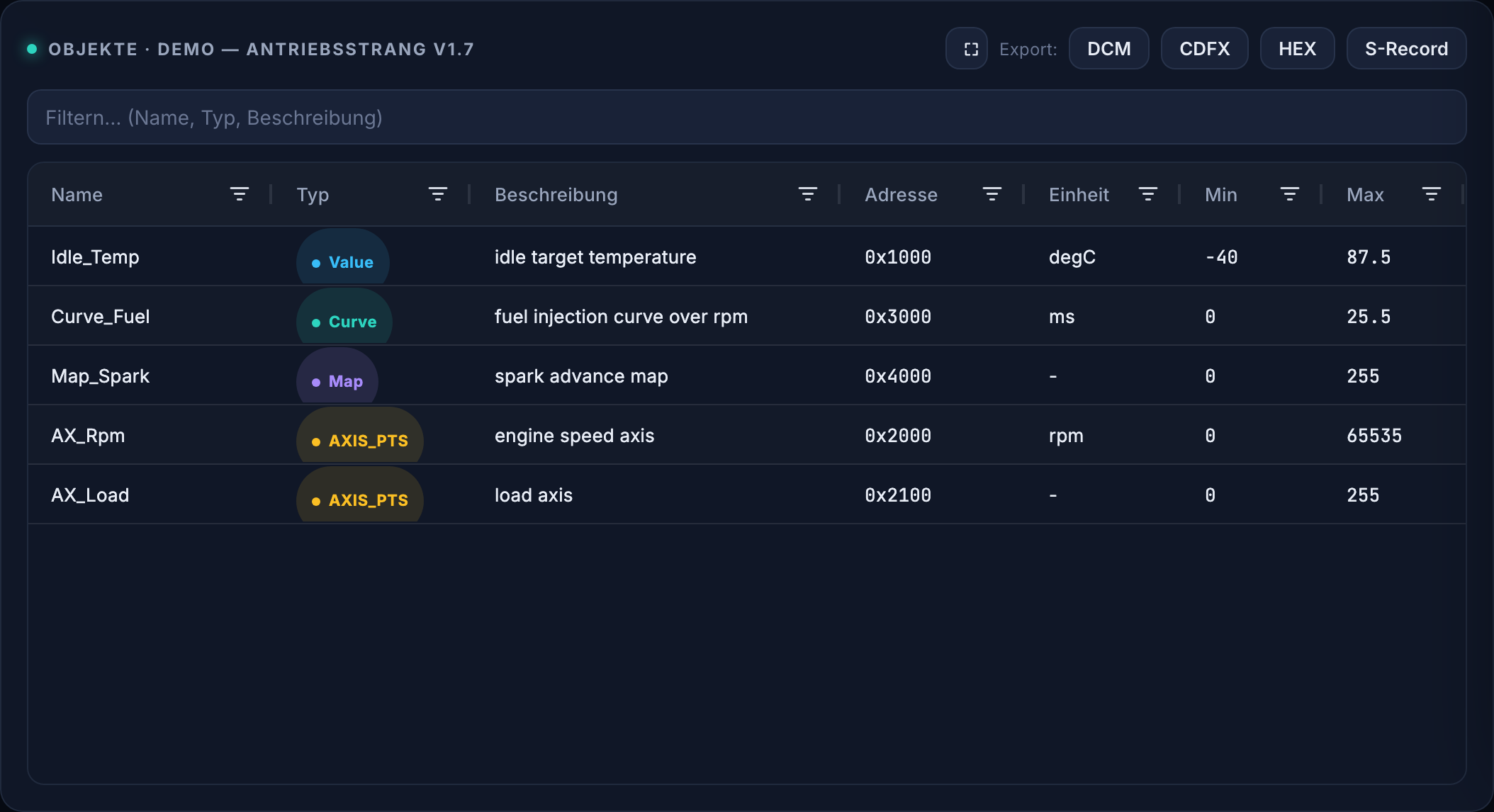
Anyone who applies control units knows the sequence: open A2L description, adjust parameters, generate a new HEX status, pass on the DCM file by mail or via a network drive. The actual engineering work – understanding characteristic maps, securing limit values, interpreting measurement data – is contained in tools that have functioned the same at their core for twenty years: locally installed, filed, without real history. This is where VersaCal comes in, our new platform for calibration data management in the automotive industry.
VersaCal runs in the browser and brings three things into the application of control units (ECU) that classic desktop tools still do not do today: reliable versioning, verifiable reviews and AI assistance, which supports the analysis of the control unit software. And this without the data leaving the house.
Versioning: like Git, but for calibration data
Classic desktop tools know files, no history. If you want to see the status from three weeks ago, search for the correct HEX or DCM file in the folder and hope that the file name tells the truth. As the backbone of calibration data management, VersaCal instead provides central versioning of all calibration stands. Every change is associated with a person, a time and a reason.
The core of this is the comparison. Two software booths are compared parameter by parameter at the A2L and HEX levels – with physical old and new value and the delta in between. From a conspicuous parameter, jump directly to the associated HEX address and into the source code of the control unit. What is a laborious hand-match of two exports in desktop tools becomes a comprehensible diff.
Reviews and release with proof
In many teams, releasing a calibration stand is an informal act: a mail, a “fits so” in passing. This is hardly demonstrable. VersaCal brings the four-eyes principle into the process – reviews with comments directly on the individual parameter, a complete audit trail and a release that can be proven later. For everything that has to withstand approval or an audit, this proof is not an accessory, but the actual protection.
Before a stand is even released, the platform automatically checks the data:
- Limits and monotony: If a parameter violates its allowed limits or tips a characteristic curve that should actually rise monotonously, VersaCal reports this before anyone in the vehicle notices it.
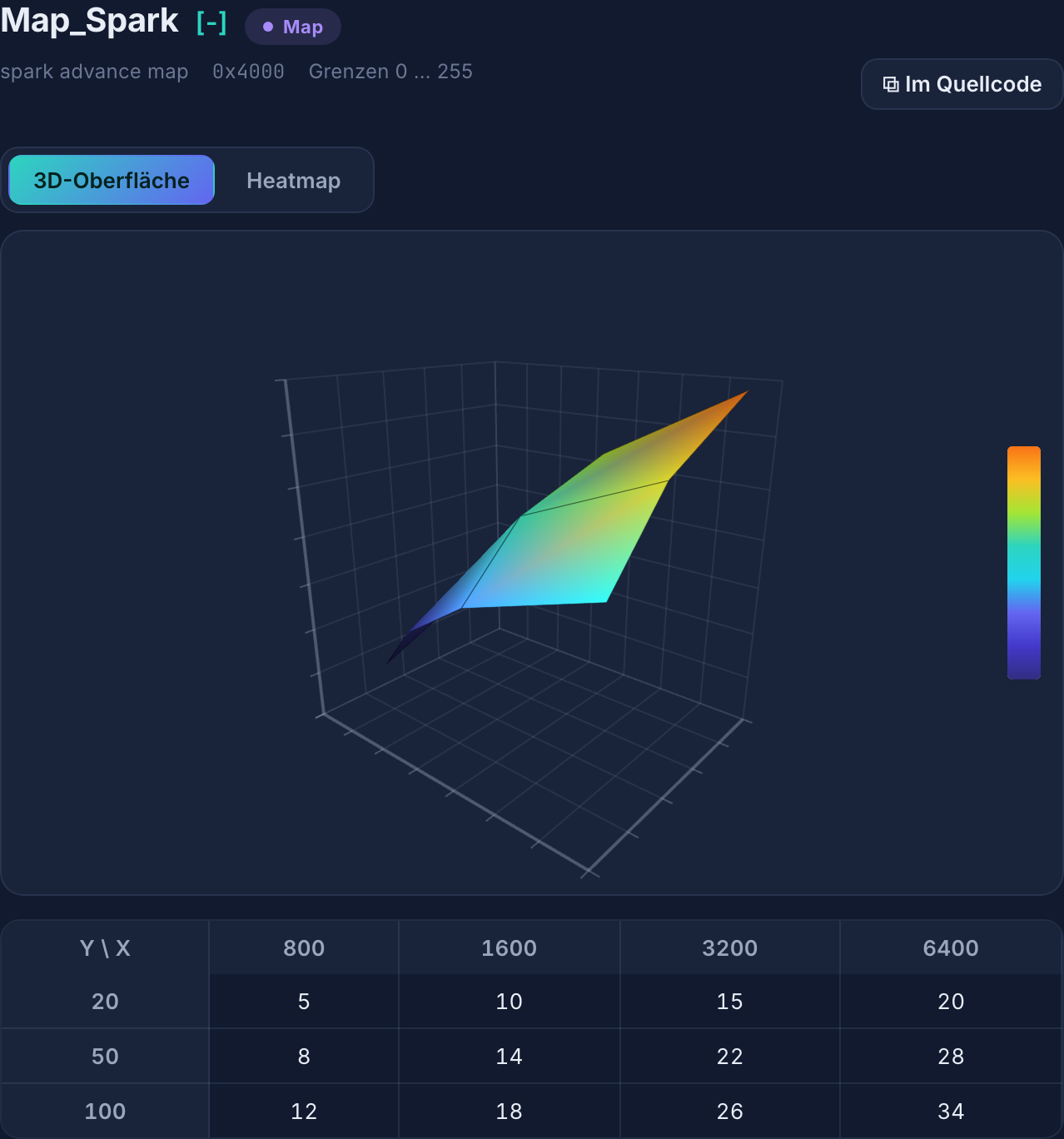
- Gradients and saddle points: To steep transitions and suspicious saddle points in characteristic maps are marked – the places where application errors like to hide.
- Anomalies in characteristic curves and characteristic maps: Outliers that do not fit any physical course are automatically noticed, instead of only in the measurement drive.

On-board Diagnosis (OBD): Evidence withstanding approval
A large part of the control unit software is not used for driving, but for monitoring. The on-board diagnostic (OBD) checks whether the emission-related systems are working and reports deviations. The associated thresholds, monitors and limit values are strictly regulated – every change must be documented and traceable compared to type approval. With file-based tools, this proof is manual work.
In VersaCal, OBD-relevant calibration stands go through the same reviews, the same audit trail and the same automatic check as everyone else – except that complete traceability is not a freestyle, but a duty. OBD departments can see at any time who has changed which threshold value when and with which justification, and can prove a release even years later.
Measurement data directly from the control unit
Application without measurement is blind. VersaCal connects XCP and takes measurement data live from the control unit, without the detour via cached files. Results flow back into the process as HEX, S-Record or Delta-DCM. If a new A2L or software status is pending, the platform ports existing calibrations with AI-based parameter recognition – instead of someone manually assigning hundreds of labels.
AI assistance for control unit software
AI is in VersaCal assistant, not autopilot. It summarizes the changes between two stands in words, assesses their risk and answers questions about control unit software. It can be instructed in natural language – for example “show me all parameters that affect the exhaust aftertreatment”. A review bot comments on changes, a knowledge assistant helps to classify unknown parameters.
For many of our customers, one point is crucial: The AI runs optionally via company-owned endpoints. The calibration data are therefore not given to a foreign service for the analysis, but remain in their own environment.
Data protection compliant because the data remains with you
Calibration data is sensitive. They contain development knowledge, and often depend directly on emissions and safety functions. Therefore, VersaCal runs where this data belongs: in your infrastructure. On-premise in your own data center, without any external connections, or in your private cloud. The access depends on the company’s identity – Microsoft Entra ID, SAML or OIDC – and the operation remains GDPR compliant because the data does not leave its own environment.
Calibration data management that grows with the process
VersaCal is aimed at application engineers, OBD departments and engine controller teams – all those who are pushing their limits with file-based desktop tools today. The difference is not another feature on a long list, but a different calibration data management: versioned, verifiable, with AI support and without giving the data out of hand.
VersaCal is part of our portfolio in the individual software development and our work in the Software development for automotive. Those who want to see how the platform looks in detail will find it under versacal.de. Why the operation in-house is still not a general trend, we arrange in the article to KI on-premises one.
Check out VersaCal – versioning, reviews and AI assistance for the ECU application, in your own infrastructure.