
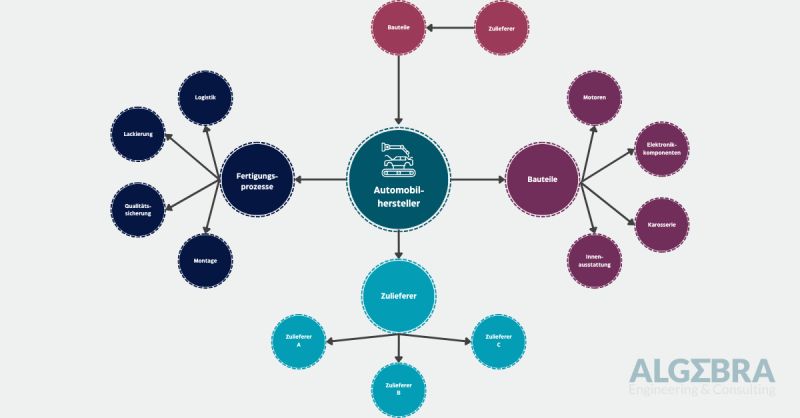
The combination of Knowledge graphs (Knowledge Graphs) and RAG systems (Retrieval-Augmented Generation) opens up new ways to not only store data efficiently, but use it intelligently and context-based. Graph- and vector-based technologies complement each other perfectly: While knowledge graphs make explicit, tested relationships visible, vector search provides a powerful, semantic contextualization of large amounts of text.
Knowledge Graph vs. Vector Search – The Difference
Both methods answer different questions. Modeling a knowledge graph Entities (components, suppliers, processes) and their Relationships as knots and edges – ideal for precise “How does X relate to Y?” questions. The vector search, on the other hand, finds semantically similar content in unstructured texts via embeddings – ideal for “What is relevant to ...?”.
| Knowledge graph | Vector search | |
|---|---|---|
| Starch | Explicit, tested relationships | Semantic Similarity and Context |
| Replies to | “How is X related to Y?” | “What is relevant to ...?” |
| Data form | Structured (entities/edges) | Unstructured (texts, embeddings) |
| Traceability | High (explicit paths) | Means (sources) |
Strong together: GraphRAG
In interaction – often GraphRAG called – both complement each other: The graph provides structure, precision and traceable relationship paths, the vector search provides range and context from documents. The result is answers that are simultaneously precise and verifiable are.
Practical example from the automotive industry
A global automotive manufacturer uses a knowledge graph to network all supply chain components – from individual components to suppliers and manufacturing processes. An RAG system based on vector search then makes complex queries possible, for example:
“Which suppliers are currently affected by geopolitical developments and how does this affect our production capacity in Europe?”
The result: precise, contextual answers and clearly comprehensible relationships between events, suppliers and production processes.
The advantages at a glance
- Transparency and traceability thanks to explicit graph structures
- Fast, semantic contextualization using vector search
- Data-driven, well-founded decisions – almost in real time
- Fewer hallucinations because answers are tied to tested relationships
When is the graph worthwhile?
Rule of thumb: Is it about Relationships, rules and origin (supply chains, parts lists, compliance, contracts), the knowledge graph plays its strength. Is it about Understanding and finding in large text stocks, leads the vector search. In practice, the combination usually wins.
At ALGEBRA, we develop exactly such solutions to redefine knowledge management and data integration. More on our side AI Consulting.
Would you like to implement this in your company? We support you pragmatically – from the idea to the operation.